
Turning Heat Data into Action: How Made-in-Nepal Low-Cost Sensors Can Help Madhesh Prepare for Extreme Heat
Published: Jun 2, 2026 Reading time: 9 minutes Share: Share an articleWhen the hot winds begin to move across Nepal’s southern plains, heat is no longer just a matter of discomfort; it changes the rhythm of daily life. School children sit in classrooms that trap heat by mid-morning. Health posts prepare patients with dizziness, dehydration, fever, and exhaustion. Farmers, construction workers, traffic police, street vendors, and daily-wage earners continue working with the temperature that grows heavier each hour. In many Terai towns, temperatures above 40°C are no longer rare events; they are becoming part of the seasonal reality of life. Recent reporting from Nepal has noted that extreme heat days above 40°C have repeatedly affected daily life in the Terai region.
Yet one important question remains: when temperatures above 40°C are becoming the new norm, who is measuring it, and how are we preparing for it?
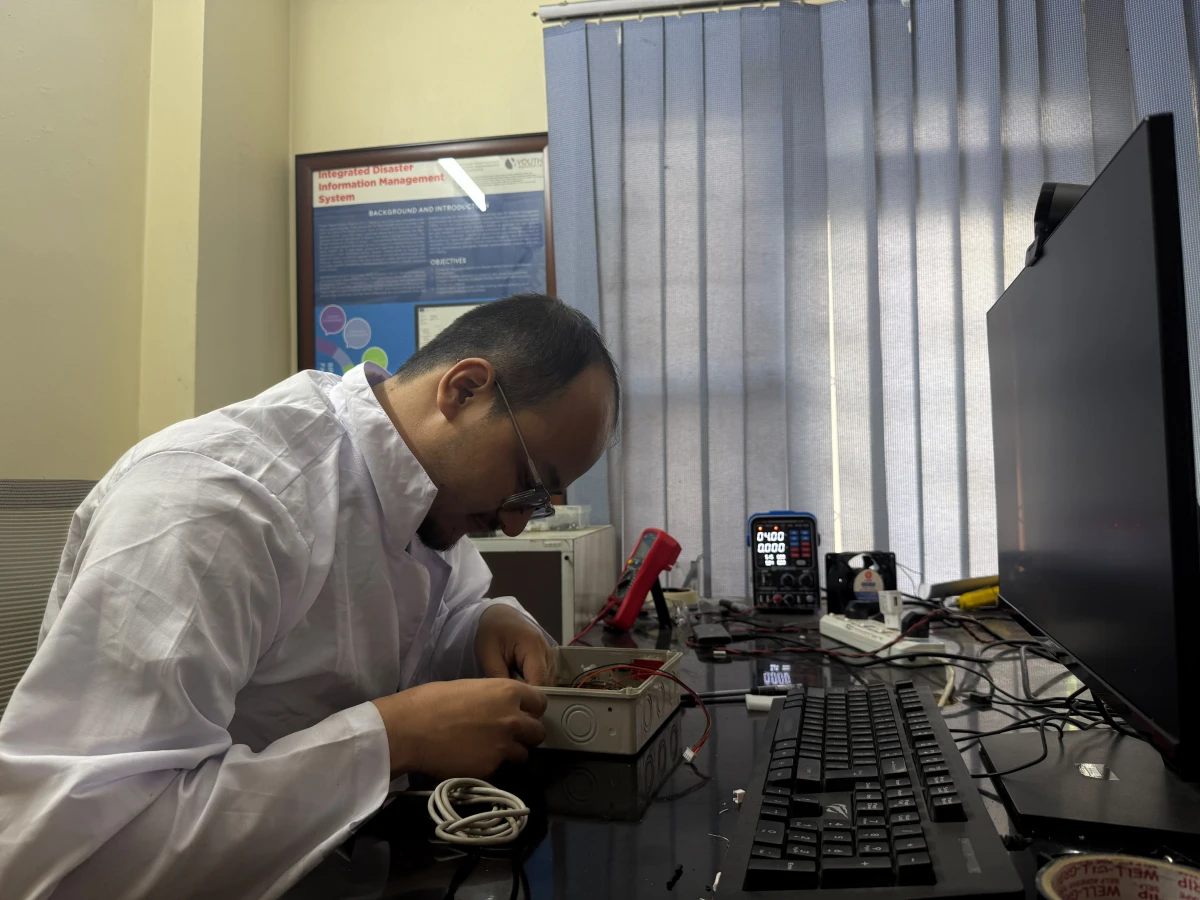
This question lies at the heart of our low-cost heat-monitoring initiative. The UK International Development funded Resilience, Adaptation and Inclusion in Nepal (RAIN) programme has developed ‘Vayu Cast,’ an environmental sensor in Nepal, which is installed in public institutions in Madhesh Province, including Gaur and Siraha municipalities, in June 2024. Through this initiative, we have locally assembled and installed 15 low-cost sensors that monitor temperature, humidity, atmospheric pressure, and air quality, transmitting live data through Global System for Mobile Communications (GSM)-enabled connectivity.
The story is not only about research and development. It is about how local innovation can fill a critical data gap in one of Nepal’s most climate-vulnerable regions. It is about how affordable technology, when designed for local conditions, can help municipalities identify heat waves earlier, respond faster, and protect the people most at risk.
The problem: heat is local, but data is often distant
The Government of Nepal (GoN) has embedded meteorological stations, which are essential for national weather forecasting and climate monitoring. But for local governments trying to plan heat action, the data is often too sparse. A single official station may represent a large area. At the same time, actual heat exposure varies sharply between a shaded school compound, a paved market, CGI sheet roofing, a health post, a bus park, a factory area, and a dense settlement with little tree cover.
This matters because heat risk is not determined by temperature alone. A day of 38°C with high humidity can be more dangerous than a drier day at 40°C. Without even reaching the heatwave threshold, heat stress accumulated over a longer time at a lower threshold can create significant health hazards. Air pollution can worsen respiratory stress. Children, older adults, people with chronic illness, pregnant women, outdoor workers, and low-income households face unequal exposure and unequal ability to cope.
That is why hyperlocal monitoring matters. A municipality cannot manage what it cannot measure. Without local data, heat action plans remain in broad documents. With local data, they can become living systems: issuing warnings, changing school timings, activating health posts, opening cooling spaces, guiding water distribution, identifying dangerous heat pockets, and protecting workers.
The spark: a low-cost sensor, Vayu Cast, built for Nepal

The team explored open-source environmental sensing models from around the world, including citizen-science approaches that used low-cost components to monitor air and weather conditions.
The real innovation and research began upon reaching Nepal’s field terrain
A sensor that works in a laboratory is not automatically a sensor that works in Madhesh. Wi-Fi may be unstable. Electricity may go out. Dust, humidity, insects, heat, and installation constraints can affect performance. A public institution may have a wall but not a reliable internet router. A device may transmit data perfectly for three days, then fail during the very hot event it was meant to monitor.
This is where the “made in Nepal and for Nepal” story becomes powerful. We did not simply import a device and place it in the field. We adapted, tested, redesigned, and improved the system based on Nepal’s infrastructure realities.
The methodology: prototype, test, fail, learn, adapt
The agile development process moved through three practical phases.
The first phase focused on the prototype and validation. We developed in-house low-cost sensors and tested whether the core architecture could collect and transmit environmental data. At this stage, the sensors were connected to platforms such as sensor.community, allowing readings to be shared openly. This phase proved that the system could work, but it also exposed a major limitation: dependence on Wi-Fi.
For public institutions in Madhesh, Wi-Fi dependence was a barrier. A heat monitoring system should not fail because a router is turned off, an internet bill is unpaid, or connectivity is weak. Heat monitoring must continue during difficult conditions, not only during ideal ones.
The second phase introduced GSM connectivity. This was a decisive step. By using mobile networks, the sensors became more deployable across municipalities where internet access may be inconsistent, but cellular networks are available. GSM shifted the sensor from a lab-friendly device to a field-ready tool.
The third phase focused on reliability and backup. The team added local data backup mechanisms and auxiliary power support so the system could continue operating during network interruptions and electricity outages.
This R&D treated the field as a real laboratory; each failure was not an endpoint but a design signal. Each technical challenge became evidence for the next iteration.
That learning is now backed by validation. In tests carried out across five stations in Kathmandu Valley, the low-cost sensors’ readings were compared with nearby Department of Hydrology and Meteorology/ World Meteorological Organisation (DHM/WMO) control stations and Open-Meteo data. The results were encouraging: the sensors closely followed daily temperature patterns, with strong agreement against reference data, while pressure readings also tracked changes reliably over time. Humidity readings tended to be slightly lower than the reference stations, and particulate matter readings were more sensitive to very local conditions such as dust, airflow, and sensor placement. In a way, this was an important finding too. It showed that the sensor itself can support local heat and air-quality monitoring, but good data depends on good installation: shade, airflow, distance from walls or vents, stable power, clean inlets, and reliable connectivity all matter. For us, this validation did not just prove that Vayu Cast works; it helped define how the sensors should be deployed so municipalities can trust the data they use for heat action.
Why public institutions matter

Installing sensors in public institutions is strategic. Schools, municipal offices, health posts, and other public buildings are not just physical sites; they are community anchors. They are places where children gather, where citizens seek services, where local governments coordinate response, and where public trust can be built.
A sensor in a public institution can do more than collect data. It can become part of a local heat awareness system. A school can adjust outdoor activities when heat thresholds are crossed. A health post can prepare oral rehydration salts, shaded waiting areas, and triage messages. A ward office can identify when vulnerable households need outreach. A municipality can compare readings across locations and understand which areas face the most severe exposure.
Over time, the data can help answer important planning questions. Which neighbourhoods heat fastest? Where are nighttime temperatures staying high? Which schools need shade, white painting or ventilation improvements first? Which areas need drinking water points? Where should cooling centres be located? Which occupational groups need targeted alerts? Which building typology aggravates and which alleviates heat? Do ponds and greening alleviate “felt “temperature?
The sensor becomes a bridge between data and decision.
Alerts: Heatwave and Cumulative Heat Stress
Low-cost sensors can support heat-wave identification in three major ways.
First, they increase spatial resolution. Instead of depending only on regional readings, municipalities can observe local variation. This is crucial in Madhesh, where built surfaces, building typology, and settlement density can create different heat exposures within short distances.
Second, they allow real-time monitoring. Heat action requires timing. A warning issued after the most dangerous hours have passed has limited value. Live data can help municipalities detect rising risk early in the day and activate a response before health impacts escalate.
Third, they capture compound risk. These sensors do not monitor temperature alone; they also measure humidity, particulate matter, and monitor accumulated heat stress over time. This is important because sustained heat and air pollution can interact. When high temperatures, high humidity, and poor air quality occur together, the heat stress on the body increases. Monitoring these variables together gives decision-makers a more realistic picture of public health risk.
Translating heat sensor data into locally led heat adaptation
Data becomes powerful only when it triggers action. A low-cost heat monitoring network can support several layers of mitigation.
At the immediate level, municipalities can use sensor data to issue localised alerts through SMS, radio, social media, community volunteers, schools, and health networks. Alerts can include simple public guidance: avoid peak afternoon exposure, drink water frequently, check on older people, reduce strenuous work during the hottest hours, and seek help when symptoms appear.
At the institutional level, schools can modify schedules, postpone outdoor assemblies, improve ventilation, and create shaded rest areas. Health facilities can prepare for heat-related cases, stock supplies, and coordinate referral pathways. Local governments can open cooling spaces in public buildings.
At the planning level, regular sensor readings can guide long-term investments. If one school compound consistently records dangerous afternoon heat, it may need trees, reflective roofing, improved airflow, white painting of buildings, or shaded outdoor areas. If a market area records extreme heat and high particulate matter, urban design and traffic management may be needed. If night time heat remains high in dense settlements, housing and land-use planning become part of heat adaptation.
The network of heat sensors acts as building blocks for local monitoring, heatwave threshold design and alerts, activate immediate local response, as well as support for long term adaptation planning.
Vayucast: Casting and Crafting Innovation locally

Innovation does not always need to be borrowed or imported. It can be designed locally, assembled locally, tested locally, and improved through action research in the field
As heat risk grows across the Terai, the most important question is no longer whether communities are vulnerable. They are. The question is whether local governments will have the data, systems, and partnerships needed to act before heat becomes a health hazard.
In Madhesh Province, Vayu Cast offers one possible answer.
This low-cost heat sensor is not just a device on a wall. It is a statement: Nepal can build climate tools that match its own geography, infrastructure, and governance needs.
And in the years ahead, as extreme heat becomes more frequent and extreme weather adds pressure to already vulnerable regions, innovation rooted in local realities becomes our strongest defence as well as our greatest opportunity to adapt to the changing climate.
The Vayu Cast is a low-cost heat sensor designed, as part of action research by Youth Innovation Lab under the UK International Development funded RAIN programme, which is led by People in Need with co-lead DCA in Nepal, with partners Community Self Reliance Centre (CSRC), Local Initiatives for Biodiversity, Research and Development (LI-BIRD), Prerana, Youth Innovation Lab, Red Cross Red Crescent Climate Centre and Met Office.
