
Living a Value: Gender Equality, Disability, and Social Inclusion at People in Need Nepal
Published: Mar 8, 2026 Reading time: 5 minutes Share: Share an articleThe strong patriarchal society of Nepal shapes the perception of Nepalese long before they ever learn to question it. We carry biases without knowing, internalise norms without noticing, and step into adulthood thinking many things are simply “the way things are” - the same applies to me. When I joined People in Need (PIN) Nepal in 2016, I did not yet know how deeply these norms lived within me or within the organisation.
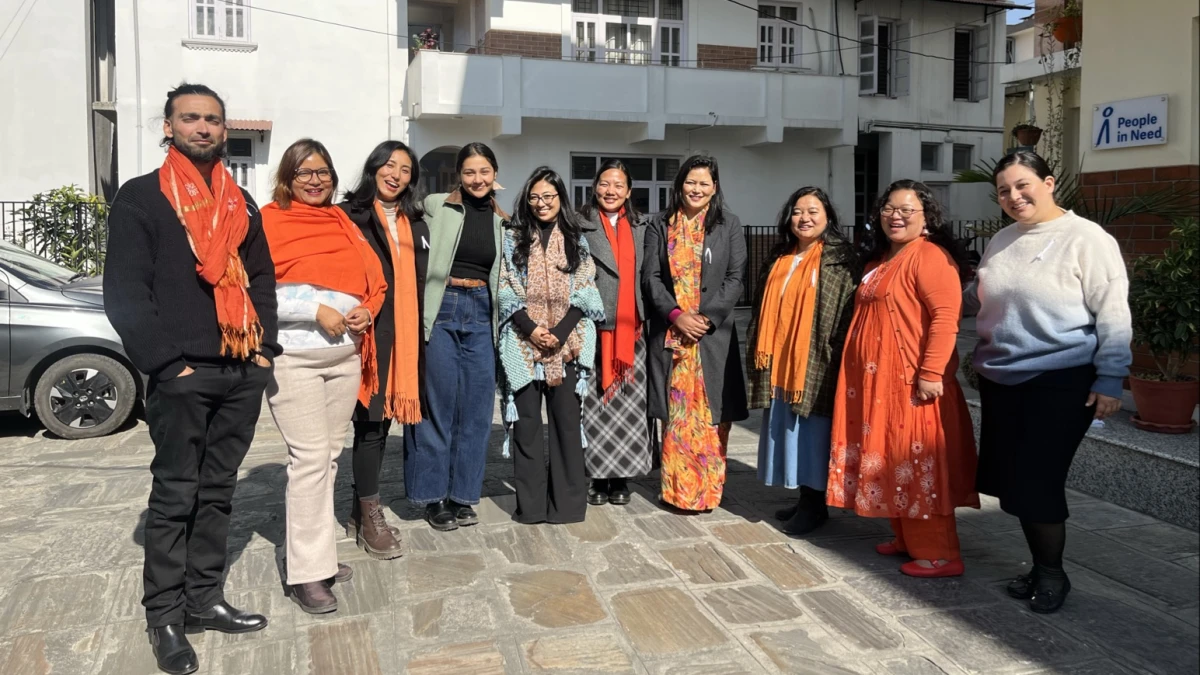
In 2017, PIN Nepal began transitioning from humanitarian response to longer term development programming. With that shift came a deeper responsibility: to ensure that conversations about gender equality, disability, and social inclusion were commitments we embodied in our everyday work. We started this shift with programmes like Safe Justice, Her Turn, Hello Saathi, Durable Solutions among others. These programmes identified that we needed a dedicated person who would ensure these values are instilled in all our programmes. Thus, I became our GEDSI (Gender Equality, Disability, and Social Inclusion) Mainstreaming Coordinator in 2019, a step towards the most transformative journeys of my life.
In the beginning, I did what felt natural: I drafted strategies, checklists, guidelines, action plans, etc. These were necessary, of course, but they were also the easy parts. I quickly realised that change needed to begin with people: their beliefs, their lived experiences, their fears, and the visible as well as their invisible biases. Before asking anyone to change, I needed to understand where we stood. So, I designed and circulated an anonymous internal survey, hoping people would be honest. They were. Some admitted they didn’t know the right words; others confessed they worried about offending someone. Many shared how casually sexist jokes had been normalised. Reading through their reflections, I realised justice can never begin without honest acknowledgment, and rights become real when people are heard.

Sometimes, the smallest actions sparked the biggest reflections. I remember the social media campaign where men colleagues completed the sentences, “I am like a girl because…” and women colleagues completed “I am proud to be a girl because….”on the occasion of International Day of the Girl Child. A male colleague wrote that he was like a girl because he enjoyed wearing nail polish. A female colleague proudly claimed her identity because she paid her own bills. These simple statements opened conversations that had never been voiced. They nudged people to reflect on gender stereotypes in ways no training module ever could.
As our commitment strengthened, so did mine. I took up the role of Protection and GEDSI Manager, leading a team of three strong feminists, supported across our strategic programmatic pillars by dedicated Protection and GEDSI Coordinators. Together, we worked to ensure GEDSI became a core principle embedded across everything we do. GEDSI has been institutionalised in PIN through our GEDSI Strategy, Action Plans, Men Engagement Strategy, GEDSI Analysis Tools, Mainstreaming Checklists, Monitoring tools, and training modules. These frameworks and guideline are mere backbones whereas the real institutionalisation has been the shift in the mindsets of the colleagues and the GEDSI culture the colleagues have embodied.
Today, GEDSI lives not only in our projects but also in our operations. We moved from “including gender activities” to dedicating actual budgets, deliberate methodologies, and meaningful indicators for inclusion. We embraced the idea that inclusion should not be siloed, and that it must be part of performance evaluations, recruitment decisions, and accountability systems. Our operations team championed procurement approaches that prioritise women-owned businesses and vendors from marginalised communities. We replaced the gender segregated toilets with accessible, gender-neutral, and period-friendly ones. Our infrastructure designs now include childcare rooms, well-being spaces, and accessibility features that reflect dignity for everyone who enters our offices.
One of the quiet pillars of this transformation has been our MEAL team. They consistently checked tools with us, ensuring sensitivity and relevance; they integrated GEDSI indicators; and they approached inclusion as something essential, something foundational. Their commitment helped ensure that our progress wasn’t just visible, it was measurable, accountable, and continually improving.
But none of this would have been possible without the collective spirit of our colleagues. I have deep gratitude for our staff who stood in front of communities and spoke about gender-based violence during the 16 Days of Activism. I cherish the moments when colleagues gently questioned government officials about the absence of women in meetings. I admire our partners who embraced our tools and made them their own. And I am thankful for every colleague who stopped treating GEDSI as a checkbox activity and started treating it as a value to live by.
This year’s global theme: Rights. Justice. Action. For ALL Women and Girls beautifully captures what we have been building. Rights must be exercised. Justice must be realised. Action must be continuous. GEDSI at PIN Nepal has never been a one-time training or a one-off activity; it is a culture, a commitment, a continuous journey of reflection and realignment.
And as we celebrate International Women’s Day 2026, my wish is simple:
Today, my colleagues no longer hesitate or fear saying the wrong thing. They step forward, ask questions, challenge stereotypes, and advocate with confidence. They do not champion GEDSI because it is required, they do it because they believe in it.
And that, to me, is what real transformation looks like.


