
Women and Water: Living Between Extremes
Published: Mar 21, 2026 Reading time: 6 minutes Share: Share an articleFor many women, their relationship with water is one of constant negotiation: between too much and too little, between floods that devastate and droughts that deplete. As the speed, intensity, and availability of water shifts with the changing climate, so does the magnitude of women’s struggles.
When There Is Too Much Water
Like many rivers around the world, the Banganga River in southern Nepal is essential to families living along its banks. But in recent years, what was once a familiar, life-giving river has evolved into a threat. Each monsoon, the river cuts deeper into the land, sweeping away soil, homes, playgrounds, and farms. As climate change has intensified this has turned an environmental concern into a fight for survival.
“Every year, the land gets swept away. This place used to extend several meters farther,” shares Karim Miya, a community member, pointing to the shrinking playground where children play freely. Beyond it lies the community’s agricultural land, the primary source of livelihood for more than twenty families. “If the erosion continues, the agricultural fields will be next”, he adds.
To protect residents, we conducted assessments and identified the most vulnerable locations. We then constructed a 90-meter gabion embankment near the playground, a structure that has brought relief to the villagers. This work was conducted through the UK International Development-funded Resilience, Adaptation and Inclusion in Nepal (RAIN) programme, in coordination with local stakeholders.
Despite repeated appeals to the local authorities, only temporary structures and small embankments had been built to restrain the river. These cannot withstand the rising force of monsoon floods. The community lived in fear that each year could be the year their homes disappeared. To protect residents, we conducted assessments and identified the most vulnerable locations. We then constructed a 90-meter gabion embankment near the playground, a structure that has brought relief to the villagers. This work was conducted through the UK International Development funded Resilience, Adaptation and Inclusion in Nepal (RAIN) programme, in coordination with local stakeholders.

For Amrita Kumari Thapa Khatun, Secretariat member of the Users’ Group for Embankment Construction, the river’s destruction has long been personal. “A few years back, the flood entered my house every year. My previous house was destroyed,” she recalls. Even after moving to a concrete home, floodwaters continued seeping into her home each monsoon. Amrita proudly shares that the users’ group consists of 11 members, of which 7 are women. Their leadership has guided community efforts from the beginning.
Earlier attempts such as small dams and makeshift barriers were not enough to withstand changing patten of rainfall. But the new embankment, properly designed and engineered with RAIN’s support, has transformed the community’s sense of safety.
“The ground where our children play is safe, and our agricultural land is protected. For the first time in years, we feel our lives are no longer constantly at risk,” Amrita explains. She also highlights how the project provided knowledge, not just infrastructure, to the community. “We learned which plants to grow, how to fill gaps behind the embankment, and how to maintain it. RAIN has educated us.”
The community now hopes for similar permanent works along other vulnerable stretches of the river. For the people of Banganga, the river is both life and danger. It irrigates their fields, sustains livestock, and shapes their land. Yet it also threatens their homes and their future. With the new dam construction in Kapilvastu District, the community have regained a sense of safety, dignity, and hope. The river may continue to flow and shift its course, but the people of Banganga can resist it; united by their labour, their leadership, and their collective determination to protect their homes from catastrophes.
When There Is Too Little Water
While floods overwhelm, droughts quietly suffocate communities.
On 10 July 2025, Satish Kumar Singh, the Chief Minister of Madhesh Province, officially declared the province drought affected. In response, a Rapid Gender Analysis (RGA) was conducted to examine the gendered impacts of drought in the districts of Mahottari, Sarlahi, and Siraha in Nepal. The study showed that the drought has severely impacted women and girls, intensifying their mental stress and workload. Many have had to travel farther for water, spend more time on household chores, and face greater childcare challenges. Some girls dropped out of school, while others experienced increased risks of violence.
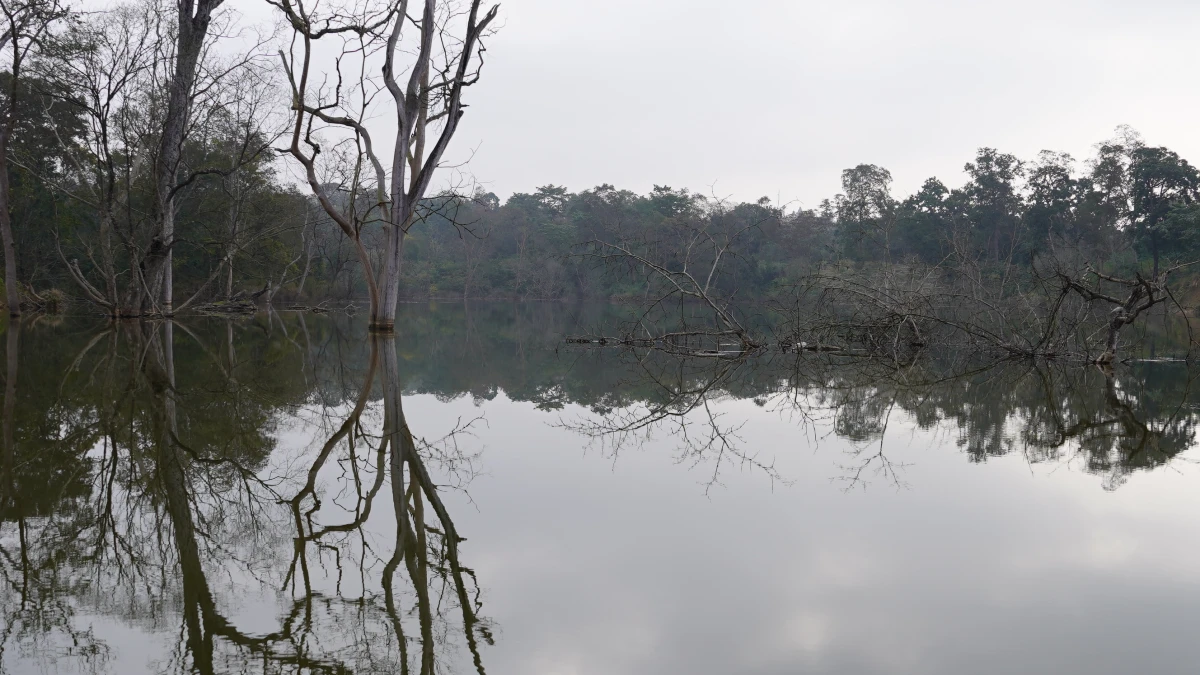
In Teliya, a large natural pond that sits at the heart of the village of Dang District. This has long been both a blessing and a curse. During monsoons, it overflows, sending water into nearby homes—including that of Ranju Chaudhary. Ranju vividly recalls the fear. “A few years back, my house was almost submerged when the pond overflowed. Living here with my children during the rainy season was frightening,” Ranju recalls.
Yet despite this recurring hazard, the pond remains vital to livelihoods in the community. Its can irrigate up to 25–30 bighas (15.5–18.75 acres) of farmland. It also plays a crucial role in groundwater recharge, biodiversity conservation, and cultural traditions such as Ghongi (snail) farming.
With support from the local government and the Community Forest User Groups, the community had made multiple attempts to strengthen the pond’s dam. But without proper engineering, their efforts were insufficient. Understanding the agricultural, ecological, and cultural significance of the pond, we collaborated with the municipality and Community Forest User Groups to restore the pond using Nature-based Solutions (NbS).
An earthen dam was fortified with bamboo wattling, bamboo crib structures, and vetiver grass plantation—plants known for their deep, soil binding roots. “For the first time in years, I feel safer,” Ranju says with visible relief. “These plants keep the soil intact and make the dam stronger. Now I feel more secure staying here with my kids”, she added.
Women as Resilience Champions
Whether facing too much water or too little, women often carry the heaviest burdens. But they also rise to the challenges of their communities leading user committees, advocating for change, restoring ecosystems, and safeguarding homes and futures.
On World Water Day 2026, under the theme Water and Gender, the RAIN Programme amplifies the voices and leadership of women protecting their homes, shaping climate solutions, and redefining resilience across Nepal’s flood‑prone regions.
From the eroding banks of Banganga to the culturally significant ponds of Lamahi, the stories above reveal a simple truth: women can lead in water governance, they can help whole communities become stronger, safer, and more resilient.
Through the restoration of old ponds, the construction of new ones, and the strengthening of embankments, water landscapes across Madhesh and Lumbini Provinces are being reshaped. But at the heart of this transformation are people - especially women - driving change from within their communities.
The RAIN programme led by People in Need Nepal, co-led by Dan Church Aid (DCA) Nepal with Community Self Reliance Centre (CSRC), Local Initiatives for Biodiversity, Research and Development (LI-BIRD), Youth Innovation Lab, Prerana, Red Cross Red Crescent Climate Centre and the UK Met Office are working to strengthen community resilience to climate-induced disasters, improving the accessibility and effectiveness of early warning systems, enabling timely action, and ensuring that the most at-risk populations are not left behind.
Because when women lead, resilience is not just built - it is sustained.


