
Why Disability Screening Matters for Early Action?
Published: Dec 3, 2025 Reading time: 5 minutes Share: Share an articleWhen we talk about early action, we often think of forecasts, warning systems, and advanced technology. But the truth is simpler and more urgent: early action fails if it does not reach the most vulnerable. Among those most at risk are persons with disabilities, who face unique challenges during crises. Many cannot hear or see warnings, some struggle to reach evacuation points, and others lack the documents required to access social protection schemes. Without reliable data, they remain invisible in disaster planning.
Today, as the world marks the International Day of Persons with Disabilities, the need for inclusive early action feels even more urgent. This day serves as a reminder that resilience-building must recognise and respond to the diverse needs of persons with disabilities, especially in disaster-prone contexts like Nepal.
This is why the People in Need (PIN) led Resilience, Adaptation and Inclusion in Nepal (RAIN) programme, supported by UK International Development, has placed inclusion at the heart of its work. The programme is co-led by Dan Church Aid (DCA) and implemented together with Community Self Reliance Centre (CSRC Nepal), Prerana, Local Initiatives for Biodiversity, Research and Development (LI-BIRD), and Youth Innovation Lab, with technical support from the Red Cross Red Crescent Climate Centre (RCCC) and the UK Met Office.
Grounded in a locally led approach, RAIN adopts a systemic, localised, and inclusive strategy to strengthen community resilience while supporting national government systems for early warning (EW), early action (EA) and climate adaptation. The programme aims to ensure early warning systems are accessible, early action is timely and reaches the most at-risk groups, and disaster risk reduction efforts remain sustainable and locally driven.
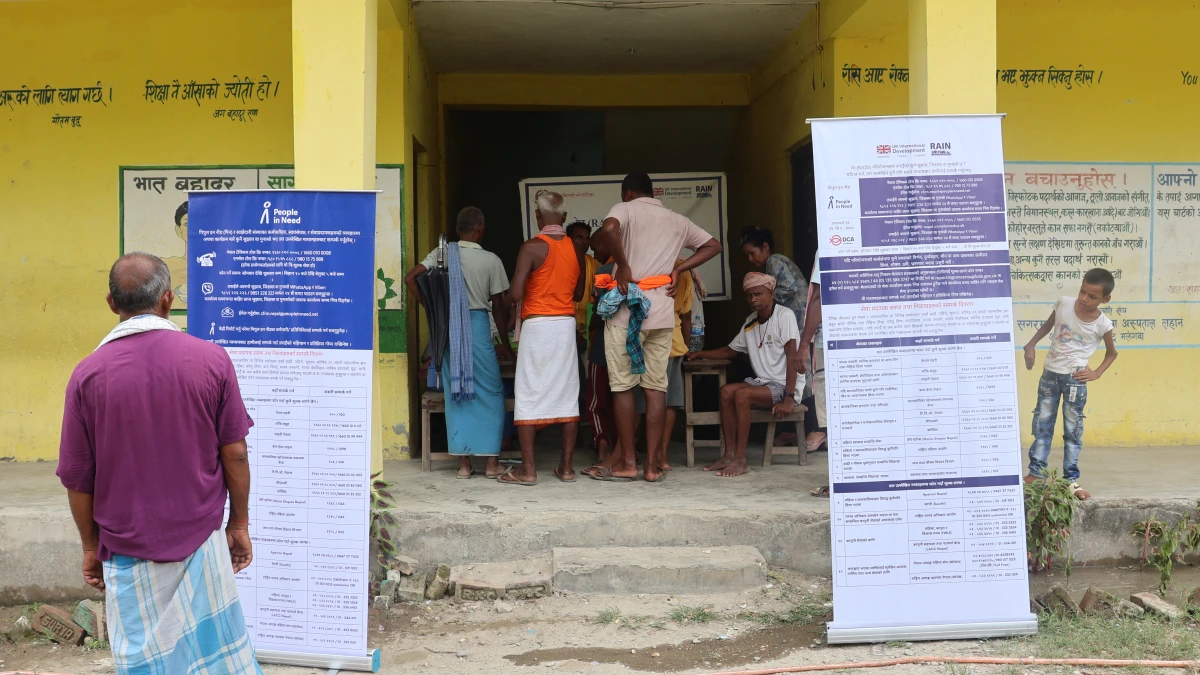
To turn this commitment into action, RAIN, together with the Government of Nepal, organised a series of disability screening camps; a vital step toward ensuring early action reaches those who are often overlooked.
A disability screening camp is a community event where individuals are assessed to identify different types of disabilities and their specific needs. These assessments help highlight gaps in existing early warning systems and guide how early action can be better tailored.
Disability Screening Camp


Across Madhesh and Lumbini provinces, 3,899 individuals were screened, and 1,630 were identified as persons with disabilities. These numbers represent real people, many of whom have been left outside the scope of disaster preparedness for years.

Reaching the Last Mile
One of the most powerful lessons from the camps was the importance of community structures. Outreach did not end at the camp venues. Teams conducted home visits to reach those unable to travel. Local health workers, volunteers, and disaster management committees became trusted links between vulnerable households and the early action system.
This is what last-mile delivery looks like: community-led outreach that ensures no one is left behind.

Why Inclusivity Matters in Early Warning
The screenings revealed a critical truth: one-size-fits-all early warnings do not work.
During the camps, 64 individuals were identified with hearing impairments. For them, common warning tools like sirens, loudspeakers, megaphones, or Interactive Voice Recording (IVR) systems are simply not accessible.
Bilti Kamati, 70, who has hearing impairment shared, “I don’t know how to use a phone and can’t hear any news on the radio. My grandchildren and neighbours provide me information and alerts. I have to be dependent on others.”
These stories show why early warning systems must offer a range of communication methods: sign language videos, pictorial alerts, door-to-door messaging, or colour-coded signals, so that everyone can understand and act in time.
From Services to Systems
The camps went beyond identification. In collaboration with local governments, individuals identified with disabilities were supported to obtain Disability Identity Cards, enroll in relevant government services, and have their data integrated into local registries for risk-informed early action.

This shift from one-off outreach to systemic, institutionalised inclusion is central to RAIN’s vision. Persons with disabilities are now recognised as key stakeholders in disaster risk management, preparedness and early action.
As Sanjib Kumar Jha, Chairperson of the Siraha Community Disaster Management Committee, explained, “We receive messages in our WhatsApp groups and then disseminate them. But not everyone has access to phones and the internet, so different mediums should be used to reach everyone.”
Accessible infrastructure is equally important. Safe shelters, inclusive evacuation routes, and appropriate emergency kits must be designed to support people with different mobility and medical needs. Only then can early action truly mean safety for all.
What Happens Next?
With the screenings completed, the crucial next step is to use this data to strengthen early warning and early action systems, so they become truly inclusive. The findings will help identify gaps in the current systems, guide more accurate targeting of at-risk households, and support the development of communication methods that are accessible for people with different abilities. At the same time, local governments will integrate this disability data into their preparedness and planning processes, ensuring that persons with disabilities are formally considered in risk assessments, resource allocation, and early action protocols.
Through these steps, the RAIN programme and government partners aim to transform the insights from the camps into long-term, locally led improvements, ensuring early warnings are not only disseminated but also understood and acted upon by everyone. In the coming days, RAIN will provide tailored support to persons with disabilities and their families, including:
1. Mobility training for individuals with physical disabilities to help them safely reach evacuation shelters during disasters,
2. Caregiver training to equip family members and caregivers of persons with disability with the skills needed to support timely and effective early action.
A Path Toward Equitable Early Action
The disability screening camps highlight a simple but powerful truth: visibility, inclusivity, community engagement, and system integration are essential to reach the last mile.
They show how we can move from generic early warnings to equitable early action; action that truly includes those too often left behind. And when early action includes persons with disabilities, it strengthens resilience for entire communities.


